Growing Hives

Uncategorized

What is a Landing Page? A Complete Guide for Beginners 📄

What is a Landing Page? A Complete Guide for Beginners In the world of digital marketing, you might have heard the term landing page quite often. But many businesses still confuse it with a normal website page or homepage. The reality is — a landing page is one of the most powerful tools for driving conversions and generating leads. Whether you are running ads, promoting a service, or launching a product, a landing page is where your audience “lands” after clicking on your offer. And what happens on that page often decides whether you gain a customer or lose one.Understanding how landing pages work can help you turn your traffic into actual results instead of just clicks. Table of Contents What Exactly is a Landing Page? 🤔 A landing page is a standalone web page created specifically for a marketing or advertising campaign. Unlike a homepage, which contains multiple links and information, a landing page is focused on a single goal or action. This goal could be anything — signing up for a newsletter, downloading an ebook, booking a consultation, or making a purchase. The entire page is designed in a way that guides the visitor towards completing that one action. In Simple Words :  A landing page is where visitors land → take action → and convert. Key Characteristics of a Landing Page : Focuses on one specific goal 🎯 Has minimal distractions or navigation Includes a strong call-to-action (CTA) Designed for conversions, not browsing Landing Page vs Website: What’s the Difference? ⚖️ One of the biggest misconceptions is that a landing page is just another page on your website. While it can be part of your website, its purpose is completely different. A website is designed to provide information and allow users to explore. A landing page, on the other hand, is designed to convert visitors into leads or customers. Key Differences :  Purpose :Website → Information and explorationLanding Page → Conversion and action Navigation :Website → Multiple pages and linksLanding Page → Limited or no navigation Focus :Website → Broad contentLanding Page → Single objective User Journey :Website → Long and exploratoryLanding Page → Short and direct Why Are Landing Pages So Important ? 🚀 Many businesses spend money on ads but fail to get results because they send traffic to their homepage instead of a landing page. This is where they lose potential conversions. A well-designed landing page ensures that your visitors are not distracted and are guided clearly towards taking action. Benefits of Using Landing Pages : Higher conversion rates compared to regular pages Better alignment with ad campaigns Improved user experience Clear messaging and focused design What Makes Them Powerful : Landing pages remove confusion. When a visitor clicks on an ad expecting a specific offer, they should land on a page that directly delivers that promise. This consistency increases trust and improves the chances of conversion. Key Elements of a High-Converting Landing Page 💡 Not all landing pages perform well. The difference between an average and a high-converting landing page lies in its structure and elements. Essential Components : Compelling Headline :Grabs attention and clearly communicates the value Subheadline :Supports the main headline with more clarity Call-to-Action (CTA) :A clear button like “Sign Up,” “Get Started,” or “Book Now” Visuals :Images or videos that support the message Social Proof :Testimonials, reviews, or trust badges Lead Form :Simple and easy-to-fill form for user information A good landing page is not just about design — it’s about clarity, trust, and simplicity. Types of Landing Pages You Should Know 📂 Different goals require different types of landing pages. Understanding this helps you create the right page for the right purpose. Common Types : Lead Generation Landing Page :Collects user information through forms Click-Through Landing Page :Guides users to another page like a checkout Sales Landing Page :Focuses on selling a product or service Squeeze Page :Captures emails with minimal content Each type is designed to serve a specific purpose, but all of them share one common goal — conversion. How to Create an Effective Landing Page 🛠️ Creating a landing page is not just about putting content together — it requires strategy and understanding of user behavior. Simple Steps to Follow : Define your goal clearly Understand your target audience Write a strong and clear headline Add a compelling CTA Keep the design clean and distraction-free Test and optimize continuously Consistency between your ad and landing page is crucial. If your ad promises something, your landing page must deliver it instantly. Final Thoughts : Your Conversion Engine 📈 A landing page is not just another web page — it is your conversion engine. It bridges the gap between attracting visitors and turning them into customers. Without a proper landing page, even the best marketing campaigns can fail. But with a well-optimized landing page, you can significantly improve your results without increasing your budget. Quick Takeaways ✅ A landing page is designed for a single goal or action It focuses on conversions, not exploration It improves ROI from ads and campaigns Clear messaging and CTA are essential A good landing page can transform your marketing results
Uncategorized

Branding vs Marketing : What Your Business Really Needs First ?

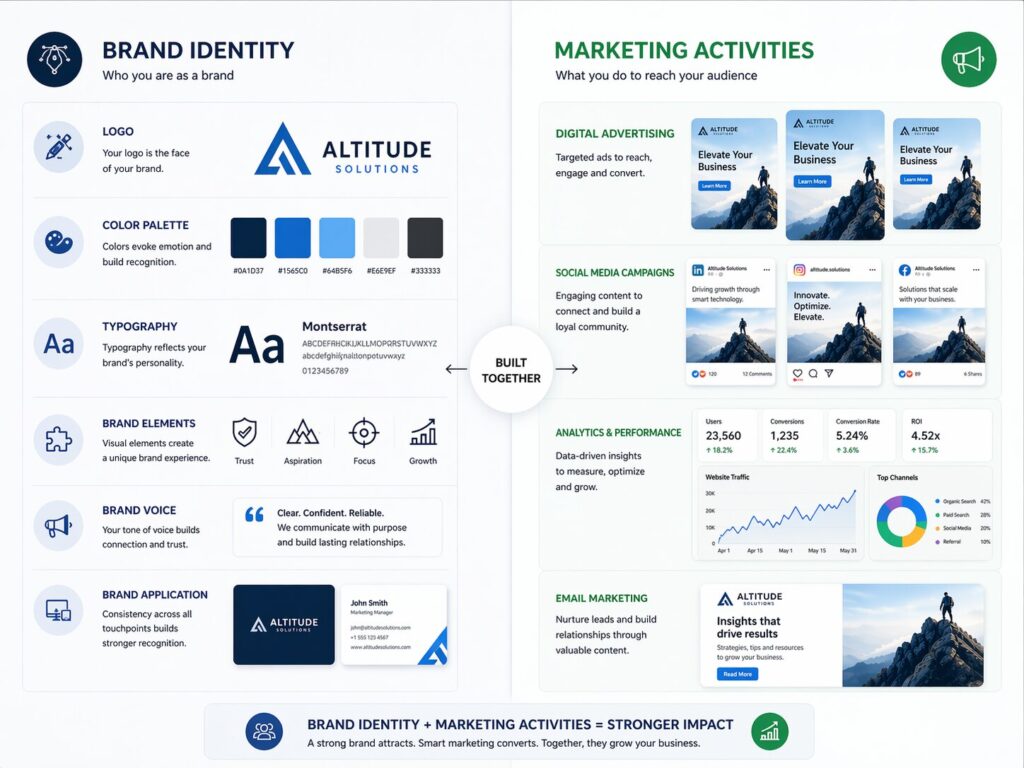
“Performance Marketing vs Traditional Marketing”Where Should You Invest? 📊 One of the most common mistakes businesses make today is confusing branding with marketing. Many assume they are the same thing, or worse — they focus on one while completely ignoring the other. This confusion often leads to inconsistent growth, weak positioning, and wasted marketing budgets. If you look closely, marketing might bring customers to your business, but branding is what makes them stay, trust, and remember you. The real question is not which one is more important — it’s which one you should focus on first based on your current stage. Understanding this difference clearly can completely change how you build and grow your business. Table of Contents What is Branding ? Branding is the foundation of your business. It is how people perceive, remember, and emotionally connect with your company. It goes far beyond just a logo or color palette — branding defines your voice, personality, values, and overall identity. A strong brand answers questions like:Who are you? What do you stand for? Why should people trust you? When your branding is clear and consistent, it creates a sense of familiarity that builds long-term relationships with your audience. Core Elements of Branding : Logo and visual identity 🎨 Brand colors and typography Tone of voice and messaging Brand values and positioning Customer experience Why Branding Matters : Builds trust and credibility over time Creates emotional connection with customers Differentiates you from competitors Increases brand recall and loyalty Common Mistakes in Branding : Treating branding as just logo design Inconsistent messaging across platforms Copying competitors instead of creating identity Ignoring customer perception Branding is not something you “do once” — it is something you build and maintain continuously. What is Marketing ? Marketing is the process of promoting your products or services to attract and convert customers. It includes all the strategies and tactics you use to reach your audience and generate sales. While branding defines who you are, marketing is how you communicate that identity to the world and drive action. Key Marketing Channels : Social media marketing 📱 Google Ads and search marketing Content marketing (blogs, videos) Email marketing Influencer and paid campaigns Why Marketing is Important : Drives traffic, leads, and sales Creates awareness about your business Helps you reach the right audience Supports business growth and scaling Challenges in Marketing : Can become expensive without strategy Results may not sustain without strong branding High competition across digital platforms Marketing is what brings attention, but without branding, that attention often doesn’t convert into long-term value. Branding vs Marketing : The Real Difference ⚖️ Instead of seeing them as separate, it’s important to understand how they complement each other. The difference lies in their purpose and impact. Key Differences That Matter :  Purpose : Branding focuses on identity and perception, while marketing focuses on promotion and conversion. Timeframe : Branding is a long-term investment, whereas marketing delivers short to medium-term results. Emotional vs Tactical : Branding builds emotional connection, while marketing drives immediate action. Dependency : Marketing campaigns perform better when backed by strong branding. What Should Your Business Focus on First ? 💡 This is where most businesses get it wrong. They jump straight into marketing — running ads, posting content, and trying to generate leads — without having a clear brand identity. As a result, their efforts feel inconsistent and fail to create lasting impact. If your branding is not clear, your marketing messages will also lack clarity. People may see your ads, but they won’t remember you or trust you enough to take action.  Start with Branding if : You are launching a new business or startup You don’t have a clear identity or positioning Your messaging feels inconsistent Customers don’t recognize or remember your brand Focus on Marketing if : Your brand identity is already well-defined You need leads, traffic, or sales quickly You want to scale your existing business You have validated your product or service The ideal approach is not choosing one over the other, but starting with a strong branding foundation and then building marketing on top of it. The Smart Approach : Build Brand, Then Scale with Marketing 🔥 The most successful businesses follow a simple yet powerful sequence — they build their brand first and then use marketing to amplify it. When branding is strong, marketing becomes more effective because :   Your messaging is clear and consistent Customers trust you faster Your campaigns perform better You stand out in a crowded market How to Combine Branding and Marketing: Define your brand identity and positioning Create consistent visuals and messaging Build trust through content and storytelling Use marketing channels to scale reach and conversions   This approach ensures that your growth is not just fast, but also sustainable and impactful. Final Thoughts : Foundation First, Growth Next 📈 Branding and marketing are not competitors — they are partners in your business growth journey. However, starting with marketing without strong branding is like building a house without a foundation. If you want long-term success, focus on creating a brand that people recognize and trust. Once that foundation is strong, marketing will naturally deliver better and faster results. Quick Takeaways ✅ Branding defines who you are; marketing promotes what you do Branding builds trust; marketing drives action Startups should focus on branding first Marketing works best when backed by strong branding A balanced approach ensures long-term growth

Uncategorized

Performance Marketing vs Traditional Marketing: Where Should You Invest?

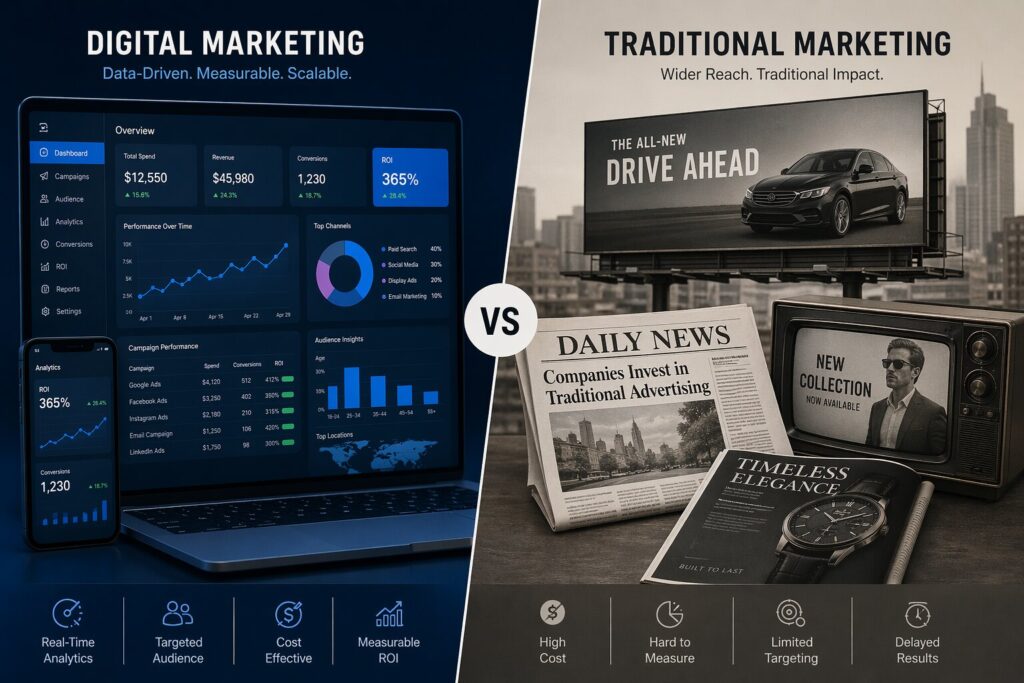
“Performance Marketing vs Traditional Marketing”Where Should You Invest? 📊 Marketing today is no longer just about reaching people — it’s about reaching the right people and getting measurable results from every rupee you spend. Businesses, especially in competitive markets, often struggle with one major decision: should they invest in traditional marketing methods or shift towards performance marketing? The answer isn’t as simple as choosing one over the other. Both approaches serve different purposes, and understanding how they impact your business growth is the key to making a smart investment decision. While traditional marketing focuses on visibility and brand recall, performance marketing is designed for data-driven growth and ROI. Table of Contents What is Traditional Marketing ? 📰 Traditional marketing refers to the conventional methods of advertising that do not rely on digital platforms. These methods have been used for decades and are still effective when the goal is to build mass awareness and brand presence. Even in today’s digital age, traditional marketing plays a significant role in shaping consumer perception. Seeing a brand on a billboard or television repeatedly creates familiarity, and that familiarity often leads to trust over time. Common Traditional Marketing Channels : Television commercials Flyers, brochures, and event promotions Outdoor advertising like billboards Newspaper and magazine ads Radio advertising Strengths of Traditional Marketing : Builds strong brand recall and recognition Reaches a wide and diverse audience Enhances credibility and brand trust Works effectively for large-scale awareness campaigns Limitations You Should Consider : Difficult to measure exact ROI Requires high upfront investment Limited audience targeting capabilities Slow feedback and optimization process Traditional marketing is ideal when your focus is on visibility and long-term branding, but it lacks the precision required for performance-driven growth. What is Performance Marketing ? 🚀 Performance marketing is a results-oriented digital strategy where businesses pay only when a specific action is completed, such as a click, lead, or sale. It is built for brands that want full control over their marketing performance and spending. What makes performance marketing powerful is its ability to provide real-time insights and continuous optimization. Instead of guessing what works, you rely on actual data to make informed decisions. Key Performance Marketing Channels : Google Ads (search and display) Social media ads (Instagram, Facebook) Affiliate marketing Influencer collaborations Native and programmatic advertising Why Businesses Prefer Performance Marketing : Highly targeted audience reach Real-time tracking and measurable results Flexible budget control and optimization Scalable campaigns with better ROI Challenges to Keep in Mind : Requires continuous monitoring Requires continuous optimization Increasing competition can raise ad costs Needs proper strategy and expertise Performance marketing is best suited for businesses that want growth, leads, and measurable outcomes, rather than just exposure. Performance Marketing vs Traditional Marketing : Key Differences ⚖️ To make a smart decision, it’s important to understand how these two approaches differ in real-world scenarios, not just in theory. Core Differences That Matter :  Measurability : Traditional marketing relies on estimated reach, while performance marketing provides exact data on clicks, leads, and conversions. Cost Efficiency : Traditional campaigns often require large investments with uncertain returns, whereas performance marketing allows controlled and optimized spending. Audience Targeting : Traditional marketing targets a broad audience, while performance marketing focuses on highly specific and relevant users. Speed of Results : Traditional marketing takes time to show impact, while performance marketing delivers faster insights and quicker adjustments. Where Should You Invest Your Budget? 💰 The right investment decision depends largely on your business goals and stage of growth. If your primary objective is to create awareness and establish a brand presence, traditional marketing can still play a role. However, if your focus is on generating leads, driving sales, and scaling your business, performance marketing becomes the more practical choice. For startups and growing businesses, budget efficiency is crucial. Spending large amounts on channels that cannot be measured accurately can slow down growth. Performance marketing, on the other hand, allows you to test campaigns, analyze results, and improve continuously. Recommended Budget Allocation Strategy: 70% Performance Marketing → Focus on conversions and growth 20% Branding & Content → Build trust and authority 10% Experimental Channels → Test traditional or new strategies This approach ensures that your marketing efforts are not just cost-effective, but also aligned with long-term business goals. The Hybrid Approach : Best of Both Worlds 🔥 Instead of choosing one over the other, many successful brands combine both strategies to maximize their impact. Traditional marketing helps in building awareness, while performance marketing ensures that this awareness is converted into actual results. For example, a brand might use billboards or print ads to create visibility and then run digital campaigns to retarget interested users. This creates a seamless customer journey from awareness to conversion. How a Hybrid Strategy Works :  Awareness → Traditional marketing Engagement → Content and social media Conversion → Performance marketing This balanced approach allows businesses to leverage both reach and efficiency without compromising on ROI. Final Thoughts : Invest Where Results Are Measurable 📈 Marketing today is about making smarter decisions, not just bigger investments. While traditional marketing still holds value in building brand perception, it is no longer enough on its own in a digital-first world. Performance marketing gives you the ability to track, optimize, and scale, making it the preferred choice for businesses aiming for consistent and measurable growth. Quick Takeaways ✅ Performance marketing focuses on measurable results and ROI Traditional marketing is effective for awareness and branding Growing businesses should prioritize performance marketing A hybrid strategy delivers the best long-term outcomes

Uncategorized

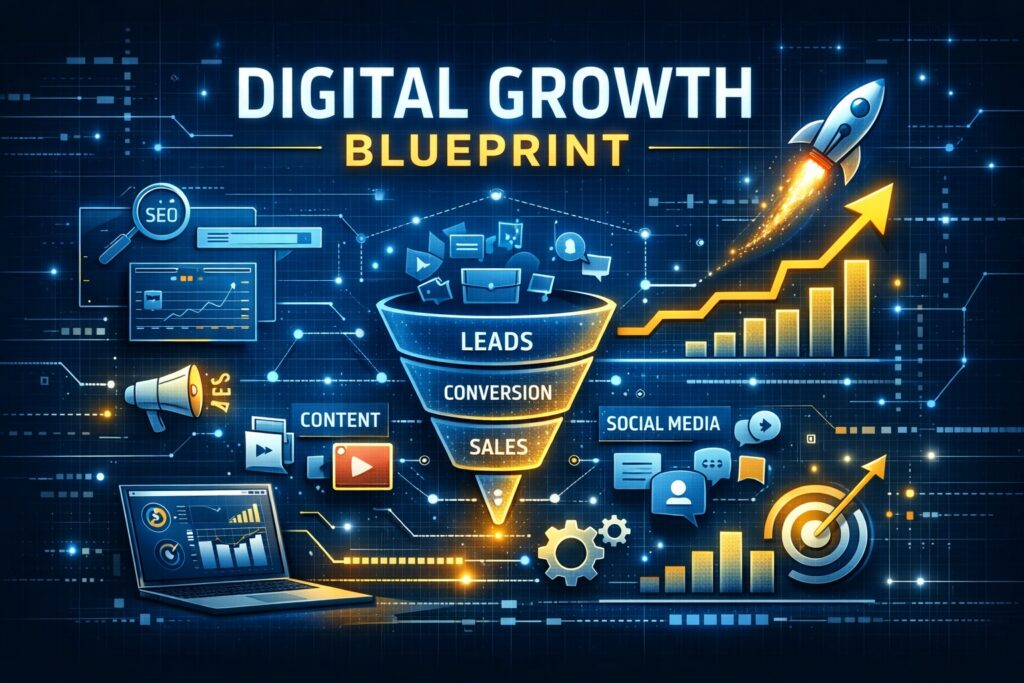
The Digital Growth Blueprint : How Smart Brands Scale Faster with a Digital Marketing Agency In Delhi​​

The Digital Growth Blueprint : How Smart Brands Scale Faster with a Digital Marketing Agency In Delhi​ Table of Contents Growth Is Not About Doing More, It’s About Doing Right In today’s digital world, growth isn’t about doing more — it’s about doing things that actually work. A lot of businesses are already putting in the effort. They’ve got a website, they post on social media, and they even spend money on ads. But still, the results don’t match the effort. That’s where the frustration starts. The truth is, it’s not about working harder — it’s about having the right direction. When your marketing feels scattered and disconnected, it’s almost impossible to see real growth. This is exactly where a Digital Marketing Agency In Delhi can make a difference. Instead of trying random things and hoping something clicks, you start following a clear system that’s actually built to grow your business. Why Most Businesses Lack Direction Most businesses skip the basics and jump straight into execution. They launch their website, start posting on Instagram, maybe run a few ads — but there’s no real plan behind it. Everything is happening, but nothing is truly working together. A good Digital Marketing Agency In Delhi doesn’t start with “let’s run ads.” It starts with understanding your business — what you want, who you want to reach, and how you want to be seen. That clarity changes everything. Turning Your Website Into a Conversion Tool Once that foundation is clear, your online presence starts to make more sense. Your website stops being just a design and starts becoming a tool. It guides people, answers their questions, and makes it easy for them to take action. Whether it’s filling a form or getting in touch, every part of it starts working with a purpose. A reliable Digital Marketing Agency In Delhi makes sure your website isn’t just attractive, but actually helps you convert visitors into real leads. Visibility: Being Found at the Right Time Then comes visibility — because no matter how good your business is, it won’t grow if people can’t find you. This is where SEO and ads come in. SEO helps you show up over time, while ads give you quick visibility. But the real results come when both are planned properly. A smart Digital Marketing Agency In Delhi doesn’t treat them separately — it connects everything so you get results now and build for the future at the same time. Content That Actually Connects Content is another area where most businesses struggle. Posting just for the sake of staying active doesn’t work anymore. People don’t care about random posts — they care about value. They want to know how you can help them, what makes you different, and why they should trust you. With the right approach from a Digital Marketing Agency In Delhi, your content starts doing exactly that — it connects, builds trust, and slowly turns attention into interest. Guiding Customers Through the Funnel And then there’s the journey your customer takes. Not everyone who visits your page is ready to buy instantly. Some people are just exploring, some are comparing, and some need time to trust you. That’s why having a proper funnel matters. A professional Digital Marketing Agency In Delhi helps guide people step by step, without forcing anything, making the whole experience feel natural instead of pushy. The Power of Consistency Consistency is something that often gets ignored. Many businesses start with full energy but slowly lose momentum. Posts become irregular, messaging gets unclear, and engagement drops. Over time, this affects how people see your brand. Working with a Digital Marketing Agency In Delhi helps you stay consistent, so your brand always feels active, reliable, and present. Data-Driven Growth (No Guesswork) One of the biggest advantages of digital marketing is that nothing is based on guesswork. You can actually see what’s working and what’s not. Every click, every interaction, every result tells you something. A results-focused Digital Marketing Agency In Delhi uses this data to keep improving, so you’re not wasting time or money — you’re building something that keeps getting better. When Everything Works Together, Growth Happens At the end of the day, growth doesn’t come from doing everything — it comes from doing the right things, in the right way. When your website, your content, your ads, and your strategy all work together, everything feels smoother and more effective. That’s what a Digital Marketing Agency In Delhi really brings — not just services, but clarity and direction. Because in a space where everyone is trying to be seen, the brands that grow are the ones that are clear, consistent, and intentional. And once you get that right, growth doesn’t feel confusing anymore — it just starts to happen. 🚀

Uncategorized

🚀 How Digital Marketing Can Help You Grow Your Business ?

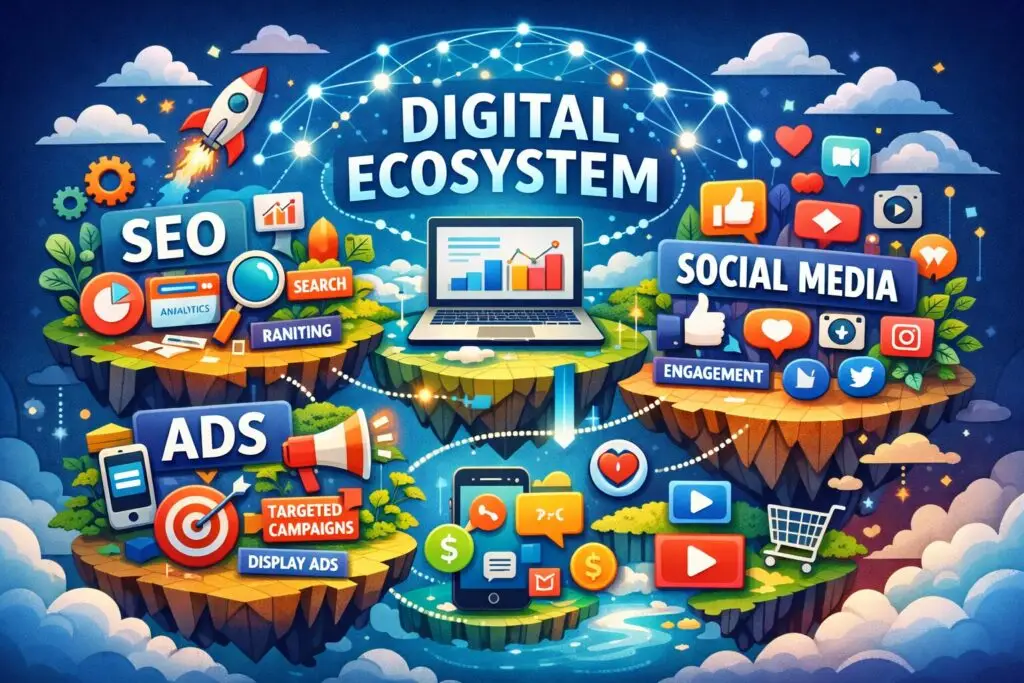
🚀 How Digital Marketing Can Help You Grow Your Business ? In today’s highly competitive and digitally influenced marketplace, businesses must go beyond traditional methods to achieve sustainable growth. The way consumers discover, evaluate, and interact with brands has evolved significantly, with most journeys now beginning online. In this environment, Digital marketing has become a critical driver of visibility, engagement, and long-term success. Modern customers expect convenience, personalization, and instant access to information. Digital marketing enables businesses to meet these expectations by creating meaningful interactions across multiple digital touchpoints. From search engines and websites to social media platforms and email communication, Digital marketing ensures that your business remains accessible and relevant at every stage of the customer journey. By implementing well-structured Digital marketing strategies, businesses can not only attract attention but also build trust, generate qualified leads, and create scalable growth systems that deliver consistent results over time. Table of Contents 🔹Understanding Digital Marketing​ At its core, Digital marketing refers to the use of online platforms, tools, and technologies to promote products and services in a measurable and targeted way. Unlike traditional marketing, Digital marketing allows businesses to interact directly with their audience while continuously analyzing performance. The importance of Digital marketing lies in its ability to adapt quickly to changing consumer behavior. Businesses can test strategies, gather insights, and refine their campaigns in real time. This makes Digital marketing not only efficient but also highly responsive to market demands. Furthermore, Digital marketing is not limited to promotion—it encompasses branding, customer experience, and relationship building, making it a comprehensive approach to business growth. 🌐 Establishing a Strong Online Presence​ A strong online presence is the foundation of any successful business in the digital age. Digital marketing ensures that your business is visible across key platforms such as search engines, websites, and social media channels. A well-designed and optimized website acts as the central hub of your online identity. Through Digital marketing, businesses can create consistent branding, publish valuable content, and provide a seamless user experience. These elements work together to build credibility and trust. Additionally, Digital marketing enables businesses to remain accessible at all times, allowing potential customers to discover and interact with their brand whenever they choose. 🎯 Targeting the Right Audience with Precision​ One of the most powerful advantages of Digital marketing is its ability to reach highly specific audiences. Instead of promoting products to a broad and undefined group, businesses can focus on individuals who are most likely to convert. Through advanced targeting techniques, Digital marketing allows segmentation based on demographics, interests, behavior, and location. This ensures that marketing messages are relevant and personalized. As a result, businesses can achieve higher engagement rates, better conversion outcomes, and more efficient use of their marketing budget. Digital marketing transforms marketing from a generalized approach into a precise and strategic process. 📈 Driving Website Traffic and Lead Generation​ Generating consistent and high-quality traffic is essential for business growth. Digital marketing plays a central role in attracting users who are actively searching for solutions related to your products or services. Through strategies such as search engine optimization, content marketing, and paid advertising, Digital marketing brings targeted visitors to your website. These users are more likely to engage and convert into leads or customers. Additionally, Digital marketing enables businesses to design structured funnels that guide users from awareness to conversion. This systematic approach ensures a steady flow of leads and supports scalable growth. 💬 Strengthening Customer Engagement Customer engagement is essential for building long-term relationships and brand loyalty. Digital marketing provides businesses with multiple channels to interact with their audience, including social media, email marketing, and content platforms. By delivering valuable content and maintaining consistent communication, Digital marketing helps businesses create meaningful connections with their customers. This engagement builds trust and encourages repeat interactions. Moreover, Digital marketing allows businesses to gather feedback and respond quickly to customer needs, improving overall satisfaction and experience. 💰 Cost-Effective and Scalable Growth One of the key benefits of Digital marketing is its cost-effectiveness. Compared to traditional advertising methods, Digital marketing allows businesses to achieve better results with lower investment. Businesses can start with small budgets, test different strategies, and scale their campaigns based on performance. This flexibility ensures that resources are used efficiently and effectively. As a business grows, Digital marketing can be scaled accordingly, making it a sustainable and long-term solution for expansion. 📊 Data-Driven Strategy and Optimization A defining feature of Digital marketing is its reliance on data and analytics. Businesses can track performance metrics such as website traffic, engagement rates, and conversion rates. These insights enable businesses to evaluate the effectiveness of their campaigns and make informed decisions. Digital marketing allows continuous optimization, ensuring that strategies remain aligned with business goals. By leveraging data, businesses can improve efficiency, reduce uncertainty, and achieve better results over time. 📣 Enhancing Brand Awareness and Authority Brand awareness plays a crucial role in influencing customer decisions. Digital marketing ensures that your business remains visible across multiple platforms, reinforcing your brand identity. Through consistent content, social media activity, and online campaigns, Digital marketing helps establish authority within your industry. Over time, this builds credibility and trust among your audience. As your brand becomes more recognizable, customers are more likely to choose your products or services over competitors. 🚀 Long-Term Business Growth with Digital Marketing Sustainable growth requires a long-term strategy, and Digital marketing provides the framework to achieve this. By integrating various strategies such as SEO, content marketing, and paid campaigns, businesses can create a continuous flow of traffic and leads. This system ensures that growth is not dependent on short-term efforts but is driven by consistent and strategic actions. Digital marketing enables businesses to adapt to market changes and maintain a competitive edge. Organizations that invest in Digital marketing are better positioned to scale and achieve long-term success. 🧠 Conclusion In today’s digitally driven economy, business growth is closely tied to how effectively an organization leverages Digital marketing. It is no longer just a promotional tool,

Scroll to Top